How to Read a Coad Reader to See if You Have Gone Enough Miles for a Innova
OBD2 Readiness Monitors are simple yet powerful cocky check routines. They provide insight to the car'south self-diagnostics. This tutorial will explicate in item what the readiness monitors are.
The purpose of readiness monitors is to cocky-exam the car'southward emission control systems. The monitors are also known every bit Emissions Monitors. Similar the proper name indicates, they observe the performance of motorcar's emission related systems.
Cars may perform up to xi system tests or routines. These tests are so called readiness monitors. The output of readiness monitors tell yous whether the car's computer has completed the tests successfully.
Readiness Monitor types
There are two different types of readiness monitors: continuous and not-continuous. Continuous monitors are different in pattern from the non-continuous ones. Continuous monitors are being constantly tested and evaluated while the engine is running. The non-continuous monitors demand sure conditions to be met earlier a test tin can be completed.
The conditions necessary to run the not-continuous self-diagnostic tests vary. Some monitors crave that the car follows a predefined drive wheel routine. Some require two drive cycles because of the demand for a cool down and warm upwardly periods between. Each emission monitor can have different requirements for the conditions.
Previously, the OBD2 standard (SAE J1979) categorized each defined monitor as either one. In the latest standard edition, this definite allocation is no longer present for all of them. Thus, OBD Motorcar Doctor doesn't follow the categorization anymore either.
Continuous or Non-continuous Monitors
These monitors can be of either type. It's upwards to the manufacturer to decide.
- Misfire
- Fuel Organization
- Comprehensive Component
Non-Continuous Monitors
Non-continuous monitors are unlike for spark ignition cars (gasoline engines) and pinch ignition cars (diesel engines).
Spark ignition vehicles (Gas)
- Goad (Cat)
- Heated Catalyst
- Evaporative (EVAP) System
- Secondary Air System
- Oxygen (O2) Sensor
- Oxygen Sensor Heater
- EGR (Frazzle Gas Recirculation) and/or VVT System
Pinch ignition vehicles (Diesel)
- NMHC Catalyst
- NOx/SCR Aftertreatment
- Heave Pressure
- Exhaust Gas Sensor
- PM Filter
- EGR and/or VVT Organisation
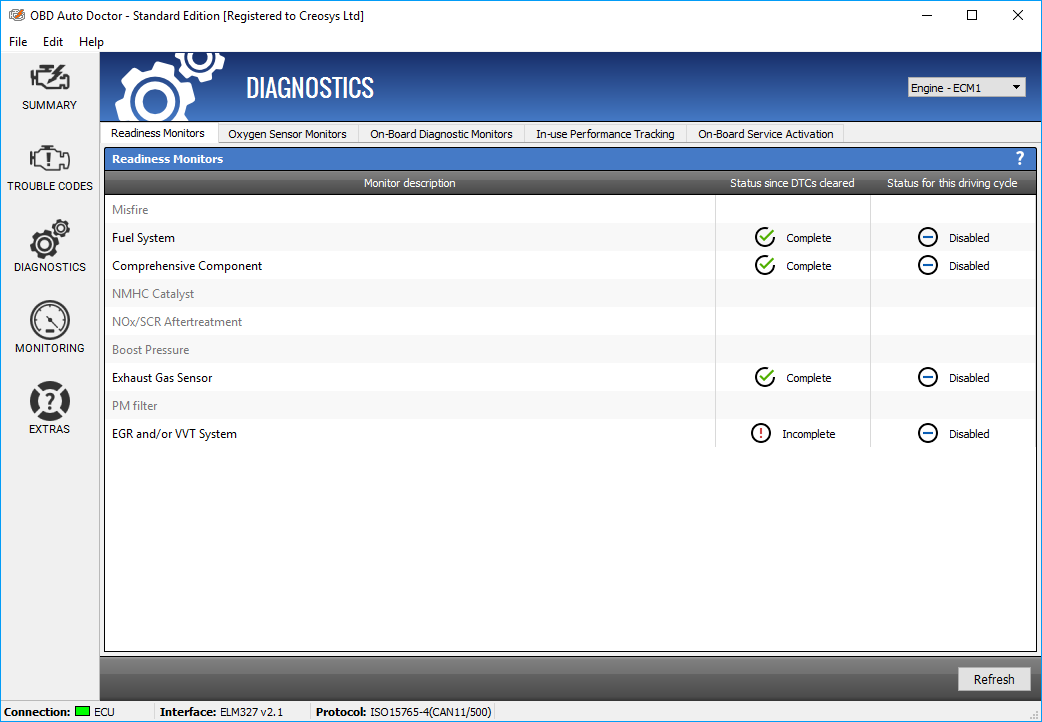
OBD readiness monitors read with Windows
Monitoring cycles
Traditionally, the only monitor condition was the status since the diagnostic trouble codes were cleared. This readiness monitor status is mandatory for all OBD2 compliant vehicles. It will show the long term condition after the check engine light was reset and the DTCs cleared.
As the OBD2 has evolved, newer vehicles can now report emission monitor status also for the electric current driving bicycle. These monitors beginning from the showtime every time when the monitoring cycle begins. Older cars might not support this feature. In that case, OBD Auto Doctor volition mark it as NA or Non Bachelor.
Monitor status
Readiness monitor test result yields the monitor status. Each readiness monitor will have its ain output status. The completion condition can be:
-
Consummate or ready meaning that the test has been completed. It means that the OBD-Ii arrangement has checked this emissions control arrangement and it has passed the test. OBD Auto Dr. indicates this by green check mark.
-
Incomplete or not set up meaning the exam is non completed. It means that the OBD2 system has not been able to run this routine or it has failed. OBD Auto Doctor indicates this by cerise exclamation marking.
-
Disabled meaning that the test has been disabled for the residual of this monitoring cycle. A monitor can be disabled when there is no like shooting fish in a barrel way for the driver to operate the vehicle to allow the monitor to run. For instance, the ambient air temperature might be too low or too loftier.
OBD Auto Doctor lists all the defined monitors in the software. But the actual status can exist reported but for the ones that the car supports too. Information technology is not required for a auto to back up all the monitors. NA or not bachelor monitor means that the auto doesn't have that monitor. Thus information technology can't exist tested.
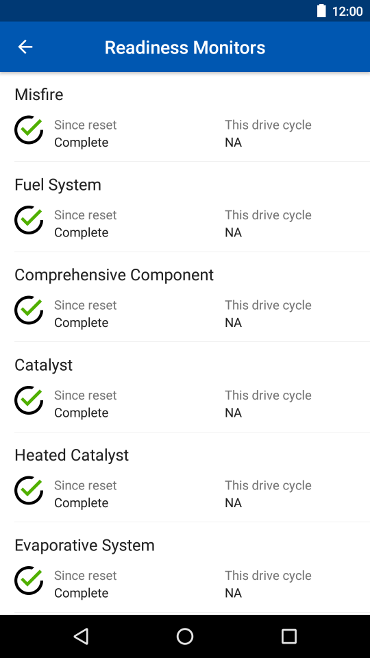
Readiness monitors read with the Android app. The vehicle doesn't back up readiness monitors for this drive bike.
Why is a monitor incomplete or "not set"
Clearing the diagnostic trouble codes (DTCs) and the Bank check Engine Lite will reset the monitor statuses too. This typically occurs during or after vehicle repair.
Statuses are also reset in case of power failure. This ordinarily happens when the battery has been disconnected. That's why it is not advisable to disconnect the battery. If y'all need to disconnect the battery for example to supervene upon it, read farther. Y'all will learn how to get the monitors back to consummate.
For the electric current monitoring cycle, or "this bulldoze bicycle", the status is set to incomplete upon starting a new monitoring cycle. It is a normal situation for these monitors to be incomplete when starting the engine.
Depending on your country and state, OBDII vehicle may not pass the annual inspection unless the required monitors since reset are complete. For example, the U.s.a. Environmental Protection Agency guidelines allow upward to two monitors to be not ready for model twelvemonth 1996 through 2000 vehicles. For 2001 and newer model yr vehicles only single monitor condition can exist incomplete or not ready.
How to get the monitors consummate or "ready"?
Considering the monitors are cocky cheque routines, the best manner to get them prepare is to drive the automobile. Even so, monotonic driving will not almost likely meet all the needed conditions. That's why there is and so called OBD drive cycle. Simply before going into that, let'southward go through the obvious ones.
-
First, make sure that the MIL (Malfunction Indicator Calorie-free) is not commanded on. Having stored or fifty-fifty awaiting diagnostic trouble codes active may prevent a monitor from running to completion.
-
Second, brand sure that you lot have enough fuel in the car. Some monitors, for example the EVAP monitor, may require the fuel level to be betwixt 35% and 85% to initiate the diagnostic testing.
-
Third, consummate the so called "bulldoze cycle". About ane week of combined city and highway driving is usually enough to allow the monitors to achieve complete condition. The drive cycle is explained in more details in the adjacent paragraph.
OBD drive bicycle
The purpose of the OBD2 bulldoze bike is to let your car run on-board diagnostics. This, in plow, allows the readiness monitors to operate. And observe potential malfunctions of your car's emission system. The right drive wheel for your car can vary greatly depending on the car model and manufacturer. Besides, the monitor in question affects the required drive cycle.
Today, many vehicle manufacturers include these bulldoze cycles in the vehicle owner's transmission. Typically, a few days of normal driving, both city and highway, volition make the monitors ready. The following generic drive wheel can be used as a guideline if a specific drive cycle is not known. Information technology will assist with resetting monitors when a machine specific drive cycle is not available. Nevertheless, it may not work for all cars and monitors.
The drive cycle can exist difficult to follow exactly under normal driving weather condition. Thus, information technology is ameliorate to drive it in restricted area!
-
The universal OBD-II drive cycle begins with a common cold starting time. You should take coolant temperature below 50 C/122 F, and the coolant and air temperatures within 11 degrees of one another. This condition tin can be achieved past letting the car to sit overnight.
-
The ignition key must not exist left ON position before the cold beginning. Otherwise the heated oxygen sensor diagnostic may not run.
-
Starting time the engine and idle the engine in drive for two and half minutes, with the A/C and rear defroster on if equipped.
-
Turn the A/C and rear defroster off, and speed up to xc km/h (55 mph) nether moderate, abiding acceleration. Hold at a steady speed for 3 minutes.
-
Slow down to 30 km/h (twenty mph) without braking. Do not depress the clutch if you are running with manual manual.
-
Speed up back to 90-100 km/h (55-60 mph) at 3/4 throttle. Agree at a steady speed for five minutes.
-
Slow down to a cease without braking.
Get ready for inspection
To avoid rejection in the almanac inspection, you tin can gear up your auto for the bank check yourself. You should at least read the readiness monitors and make sure they are fix. This will save y'all from almost guaranteed rejection.
You should also read the diagnostic trouble codes and make sure there are none present. You can do all this with OBD Auto Doctor diagnostic software. You tin read the monitor statuses and the diagnostic trouble codes even with the free version. So why not try the software correct now?
And remember, do not wait until the annual inspection with the bug. Acting immediately could salvage you a lot of time as well as future repair and fuel costs.
Editor'south notation: This tutorial has been updated in March 2020 for accuracy and the latest information.
Source: https://www.obdautodoctor.com/tutorials/obd-readiness-monitors-explained/

Post a Comment for "How to Read a Coad Reader to See if You Have Gone Enough Miles for a Innova"